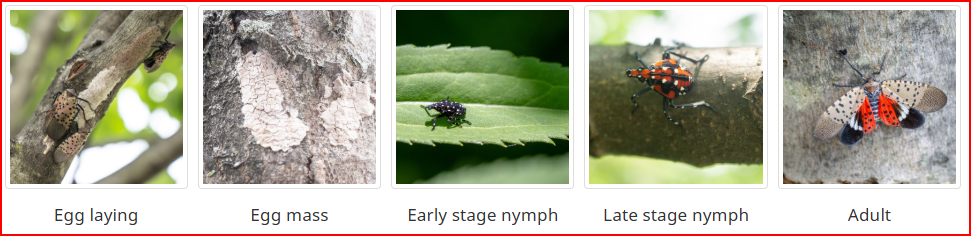
The spotted lanternfly (SLF) has been regulated by the Canadian Food Inspection Agency (CFIA) since 2018 but has not yet been detected in Canada. Since 2014 it has been spreading in the United States (U.S.) and is now present in 19 U.S. states of the United States, including those that border Canada such as New York, Ohio and Michigan.
There are many ways by which this pest can be introduced to Canada from infested areas. Those include plants and plant products as well as vehicles, containers and other things such as stone, plant pots and cargo awaiting loading that may be stored outside in infested areas. Transportation corridors are a key pathway for movement of this pest as SLF are excellent hitchhikers and can be inadvertently moved with cargo, containers or conveyances such as trucks, ships and trains. Adult SLF begin to be observed in mid-July and are killed by hard frost in late fall. Adult SLF begin egg laying in late September and can lay eggs on any flat surface. These eggs can survive our winters and pose a risk for SLF establishment in Canada.
We are asking the transportation sectors (truck, rail, vessels, planes) as well as associated industries to be on the lookout for this invasive pest; remove, kill and collect any SLF found prior to entering Canada and report any findings of SLF in Canada to the CFIA.
Please click here for PDFs of CFIA’s spotted lanternfly infographic in English and French.
Additional information, including photos to assist with detection and identification and how to report findings, can be found on the CFIA website as follows:
English: Spotted Lanternfly – Lycorma delicatula - Canadian Food Inspection Agency (canada.ca)