
https://www.cbsa-asfc.gc.ca/publications/dm-md/d10/d10-15-29-eng.html
Ottawa, April 28, 2026
ISSN 2369-2391
This document is also available in PDF (400 KB)
Plain language summary
Target audience: Importers of commercial goods
Key content: Guidelines for the tariff classification of various containers used for travel of heading 42.02
Keywords: Tariff classification, suit-cases, handbags, haversack, rucksacks, backpacks, travelling-bags.
On this page
Updates made to this D-memo
This D-memo has been updated to reflect accessibility and plain language considerations. Definitions have been added for clarity to terms used in this memorandum.
Definitions
The following definitions apply in this D-memo for the purpose of tariff classification of the suit-cases, handbags, backpacks (rucksacks) and travelling-bags of heading 42.02. These definitions are a plain language summary of various legal, technical, or policy sources.
Suit-case (may be expressed as “suitcase”)
A soft or rigid case, generally of a rectangular shape, for carrying and protecting clothes, personal belongings, etc., with a handle and a hinged lid.
Handbag
A bag held in the hand or hung from a shoulder strap and used for carrying small personal articles or money.
Haversack, knapsack, packsack and rucksack (backpack)
A bag of canvas, nylon, or other weatherproof material, carried on one or both shoulders, typically strapped on the back.
Travelling-bag
A bag without rigid outer surfaces which is generally used in the same way as a suit-case.
General Information
The following sections provide guidance for classifying suit-cases, handbags, haversacks, knapsacks, packsacks, rucksacks (backpacks) and travelling-bags.
Containers used by travellers
1. Traditionally, luggage was constructed from, or covered with, leather materials. This is why travel containers are largely provided for in Chapter 42.
2. Changes in travellers’ habits have given rise to an ongoing evolution in the design and construction of travel goods. This evolution has resulted in luggage with versatile functionality, constructed from materials that are both lightweight and durable.
3. Heading 42.02 is divided into two parts separated by a semi-colon. “Trunks” and “suit-cases” (commonly known as “luggage”) are classified in the first part of this heading. They are designed to transport and protect a traveller’s personal belongings.
4. No size or dimension criteria apply when determining whether a piece of luggage is classified as a “suit-case” or as a “travelling-bag”.
Guidelines
Suit-cases
5. Suit-cases are specifically named in the first part of heading 42.02, as well as under its first suppressed subheading.
6. Products classified as suit-cases under suppressed subheading 4202.1X generally have the following properties:
- Shape: Rectangular container with distinct top, bottom and four sides, or of other fixed shape. The top and bottom compartments are permanently joined together by a hinge, or stitched seam allowing the compartments to lay flat when opened.
- Material: Made of material that allows the suit-case to maintain its shape, even when empty (non-collapsible), from the following two options:
- Hard shell: Typically made from molded plastic, poly-carbon or light metal material with no additional support foundation.
- Flexible textile shell: Made of strong, stiff and durable material, which may have an additional support foundation to give the suit-case additional strength.
- Interior access: Suit-cases may be opened or closed by means of clasps, zippers, or straps and may also have provision for a lock.
- Handles: Suit-cases are often equipped with grab handles and/or telescoping trolley handles and may be equipped with wheels so it can be rolled on the ground.
Examples of suit-cases
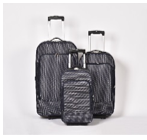
Figure 1
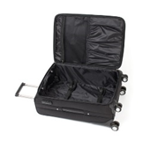
Figure 2
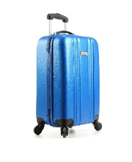
Figure 3
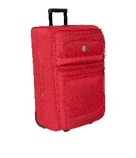
Figure 4
Handbags
7. Handbags are specifically named in the second part of heading 42.02, as well as under suppressed subheading 4202.2X.
8. The term “handbag” is not defined in the Customs Tariff or the Harmonized System. The Canada Border Services Agency (CBSA) relies on the Canadian International Trade Tribunal’s (CITT) interpretation in its decision in Michael Kors (Canada) Holdings Ltd. (AP-2018-048). In this decision, the CITT established that the term “handbag” can include smaller or larger bags which serve to carry everyday personal items.
9. The CITT also accepted that the goods marketed as “totes” or “tote bags” are considered to be similar to handbags.
10. The North American term “purse” is synonymous to a handbag. However, the English term “purse” used in heading 42.02 and associated in the Explanatory Notes refers to a small pouch used to carry money that fits into a handbag (in other words, a "change purse”).
11. Products classified as handbags under suppressed subheading 4202.2X generally have the following properties:
- Shape: Various (satchel, saddle, clutch, bucket, cross body, etc.)
- Material: Made of leather or composition leather, sheeting of plastics, textile materials, vulcanised fibre, paperboard or metal.
- Interior access: Various
- Handles: May have one or two handles; a single shoulder or cross body strap; or no handle at all (clutch style).
12. Handbags come in an assortment of styles and sizes and are designed to contain small personal items such as:
- Wallet and/or change purse
- Eyeglasses
- Keys
- Medication or cosmetics
- Hair brush or comb
- Mobile phone
13. Bags designed to accommodate items other than personal items cannot be classified as handbags.
Examples of handbags

Figure 5
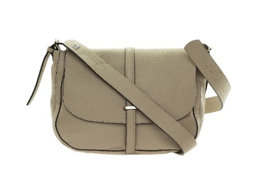
Figure 6

Figure 7

Figure 8
Haversacks, knapsacks, packsacks and rucksacks (Backpacks)
14. Rucksacks, knapsacks or packsacks (commonly known in North American as “backpacks”) are equipped with two shoulder straps to secure the pack onto the wearer’s back, while a haversack traditionally has one strap and is carried over the shoulder (see figure 11). They are all classified under suppressed subheading 4202.9X, based on the composition of their outer surfaces.
15. For tariff classification purposes, bags designed to be worn on the back with shoulder straps are classified as backpacks. Provided they are equipped with straps for wearing on the back, this includes backpacks equipped with an insulated food or beverage cooler and backpacks for carrying laptops. However, this does not include child carriers which the CITT determined to be classified under heading 63.07 in Thule Canada Inc. (AP-2022-043)
16. Backpacks are available in a variety of shapes and styles. Some suspend loosely, while others may be equipped with a metal frame and/or waist belt to help evenly distribute the pack’s load, but they generally have the following characteristics:
- Shape: Typically sack or barrel-like in its basic form and may consist of a single large sack, or be subdivided into several compartments.
- Material: Made of or covered with various materials, including leather or composition leather, sheeting of plastics, textile materials, vulcanised fibre or paperboard.
- Interior access: These packs are accessible through the top and may have separate side pockets or compartments accessed through zippers, clasps, clips, drawstrings, etc.
- Handles: The dominant characteristic of these packs is the presence of shoulder straps, although some may only have one shoulder strap. They can be also equipped with a grab handle or secondary accessories such as wheels or telescoping trolley handles.
Examples of backpacks
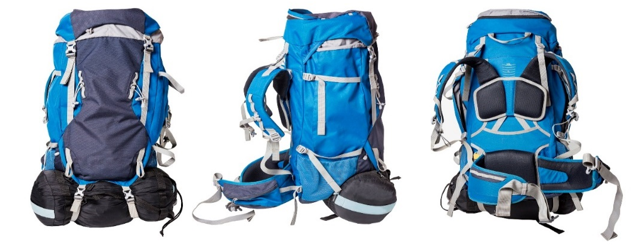
Figure 9
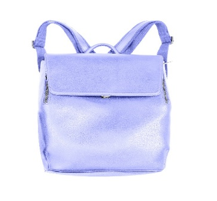
Figure 10
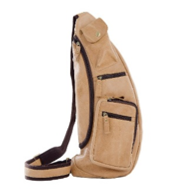
Figure 11
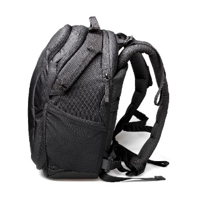
Figure 12
Travelling-bags
17. Travelling-bags are specifically named in heading 42.02 and are all classified under suppressed subheading 4202.9X, based on the composition of their outer surfaces.
18. The term “travelling-bags” includes travel goods referred to as duffle bags, hand luggage, weekend bags, overnight bags, etc. Bags classified under the above suppressed subheading have the following characteristics:
- Shape: Various (barrel, bucket, oblong, rectangular, etc.)
Some may continue to hold their shape when empty, while others may collapse, be flattened, or folded. - Material: Travelling-bags are generally made of flexible material without being rigid like a suit-case. Although they do not have hard shell exteriors like suit-cases, they may have rigid bottoms.
- Interior access: Typically accessed through the top of the bag with zippers, clasps, magnets, flaps, drawstrings, etc. and may have separate side pockets or compartments to facilitate travel storage organization.
- Handles: Handles and/or shoulder straps are a prominent design characteristic of travelling-bags. Like suit-cases, travelling-bags may feature wheels and telescoping trolley handles that allow them to roll on the ground rather than be carried in the hand or on the shoulder.
Examples of travelling-bags
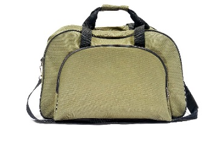
Figure 13
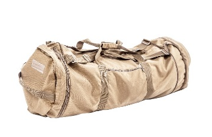
Figure 14
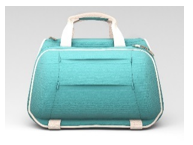
Figure 15
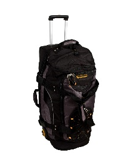
Figure 16
Additional Information
Guidelines about the methodology used to classify goods are provided in Memorandum D10-13-1: Tariff Classification of Goods.
Procedures to obtain an advance ruling for tariff classification of goods are outlined in Memorandum D11-11-3: Advance Rulings for Tariff Classification.
References
Consult these resources for further information.
Applicable legislation
Related D memoranda
- Memorandum D10-13-1: Tariff Classification of Goods
- Memorandum D11-11-3: Advance Rulings for Tariff Classification
Related links
Superseded D memoranda
Memorandum D10-15-29: Tariff classification of suit-cases, handbags, backpacks (rucksacks) and travelling-bags of heading 42.02, dated April 18, 2023.
Issuing office
Tariff Classification, Origin and Valuation Division
Trade Programs Directorate
Commercial and Trade Branch
Contact us
Contact border information services
Page details
Date modified:
2026-04-28